
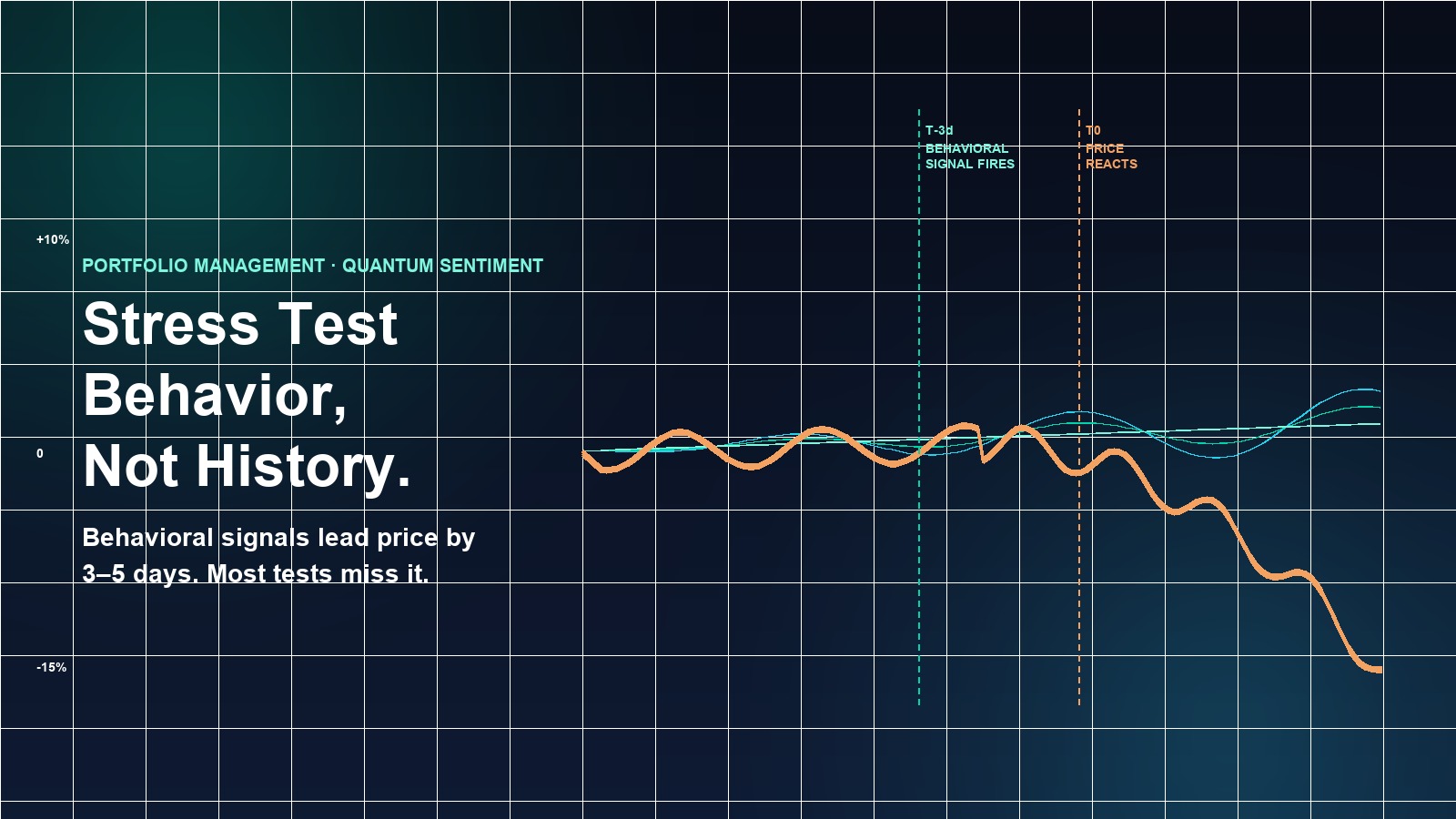
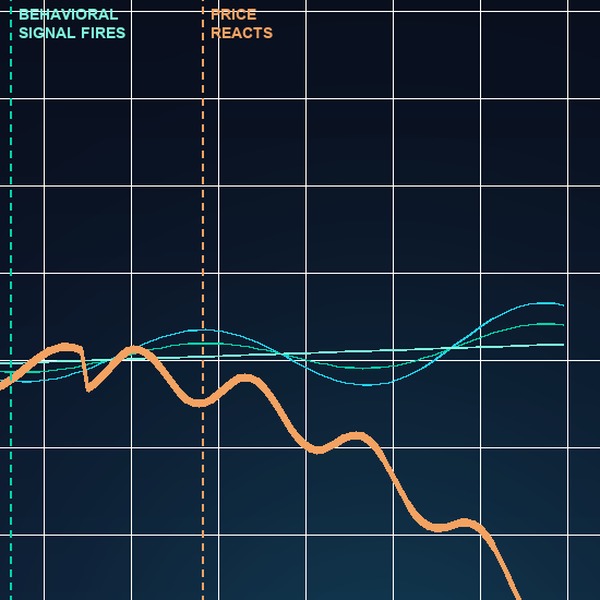
Most advisory teams already know how to stress test a portfolio. Take a scenario, apply it to the holdings and read the loss. It is a useful exercise and regulators expect it.
What the exercise does not tell you is what each client will do when that loss shows up on their statement. Some will hold. Some will call. Some will sell at the bottom and never come back. The portfolio result is the same for all of them; the outcome is not.
A behavioral stress test adds that second question. It does not try to predict markets or read minds. It uses what the firm already holds (positions, client profiles, suitability evidence and trading history) to decide which clients should hear from their adviser first.
What a Portfolio Stress Test Answers
A conventional stress test applies a historical or hypothetical shock (an equity sell-off, a jump in rates, a credit event) to current holdings and reports the result. It shows concentration, hidden correlation and the size of the drawdown a client could face.
That is the right starting point. But it measures the portfolio, not the person who owns it. Two clients with identical holdings and the same 18% paper loss can end the year in very different places, depending on what they do next.
The Question It Leaves Open
Behavioral finance has documented for decades how people respond to losses. Prospect theory showed that losses weigh more heavily than equivalent gains (Kahneman and Tversky, Econometrica, 1979). Investors tend to sell winners too early and hold losers too long, the disposition effect (Shefrin and Statman, Journal of Finance, 1985; Odean, Journal of Finance, 1998).
The cost shows up in the gap between what funds return and what investors in those funds actually earn, largely because of when money goes in and out. Morningstar has measured that gap in its annual Mind the Gap study for more than a decade.
For an advisory team, the practical consequence is simple: the moment a client is most likely to make an expensive decision is also the moment their adviser is busiest. A stress test that ends at the portfolio leaves the adviser guessing who to call.
Where the Term Comes From
In psychology, a behavioral stress test is a controlled protocol that measures how people respond to acute pressure. The best known is the Trier Social Stress Test (Kirschbaum, Pirke and Hellhammer, Neuropsychobiology, 1993).
Wealth management borrows the idea, not the laboratory. Nobody is asked to perform under observation. The test runs on data the firm already holds, and it asks how exposed each client is when the market applies the pressure.
A Behavioral Stress Test in Four Steps
The method below can be run by hand on a small book or automated on a large one. Each step uses information a regulated firm is already expected to hold.
1. Choose the scenario
Start from the same shock you use for the portfolio stress test, for example a 20% fall in equities. The point is not to forecast it; it is to decide in advance who needs attention if it happens.
2. Compare the loss with what each client said they could bear
MiFID II already requires firms to collect a client's financial situation, including the ability to bear losses, and investment objectives, including risk tolerance (Directive 2014/65/EU, Article 25(2); Delegated Regulation (EU) 2017/565, Article 54). Clients whose scenario loss or product risk exceeds that recorded tolerance are the first group.
3. Check the evidence on file
For each of those clients, is there a dated suitability record behind the current holdings? A client who is outside their profile and has no evidence on file is both a client risk and a firm risk.
4. Look at what the client has actually done
Trading history can show observed patterns: selling after falls, holding losing positions while taking profits early, concentration in a single name. These are signals, not diagnoses, and they only count where the data exists. The output is a ranked list: who to call, why, and what to discuss, prepared before the drawdown rather than after.
What a Behavioral Stress Test Is Not
It is not a prediction of what any individual client will do, and it is not a psychometric assessment. It does not replace the suitability process or the adviser's judgement.
Where data is missing, the honest answer is "unknown", not an estimate. A useful test says which clients it could not assess and why, so that the next conversation can fill the gap.
Running It on a Real Advisory Book
On a book of a few dozen clients an adviser can do this in a spreadsheet. On thousands of clients it becomes a data problem: matching holdings to product risk, profiles to tolerance, trades to evidence, and keeping the result current.
That is the job of the FinanSee Platform. A firm uploads an extract of its book (positions and client profiles are enough to start; transactions and evidence add depth). The platform expresses the result in euros (value held outside client profiles, advised volume without suitability evidence) and turns it into a ranked call list for each adviser, with the rule behind every figure.
The platform page shows a two-minute walkthrough on a synthetic book of 10,000 clients. The figures in that demo are a simulation, not client results. The only way to know what the numbers look like for your book is to run it on your data.
FinanSee Platform
Run a behavioral stress test on your own book
Send an anonymised extract of your advisory book. In an assisted pilot we return the clients outside their profile in euros, the evidence gaps and a ranked call list with the reason for each client, and you compare it with your current method before deciding anything else.
See the PlatformGeneral information, not investment, legal or compliance advice. FinanSee signals are rule-based and computed only from the data a firm provides; they do not predict individual client decisions. Each institution remains responsible for its suitability assessments and regulatory interpretation.